
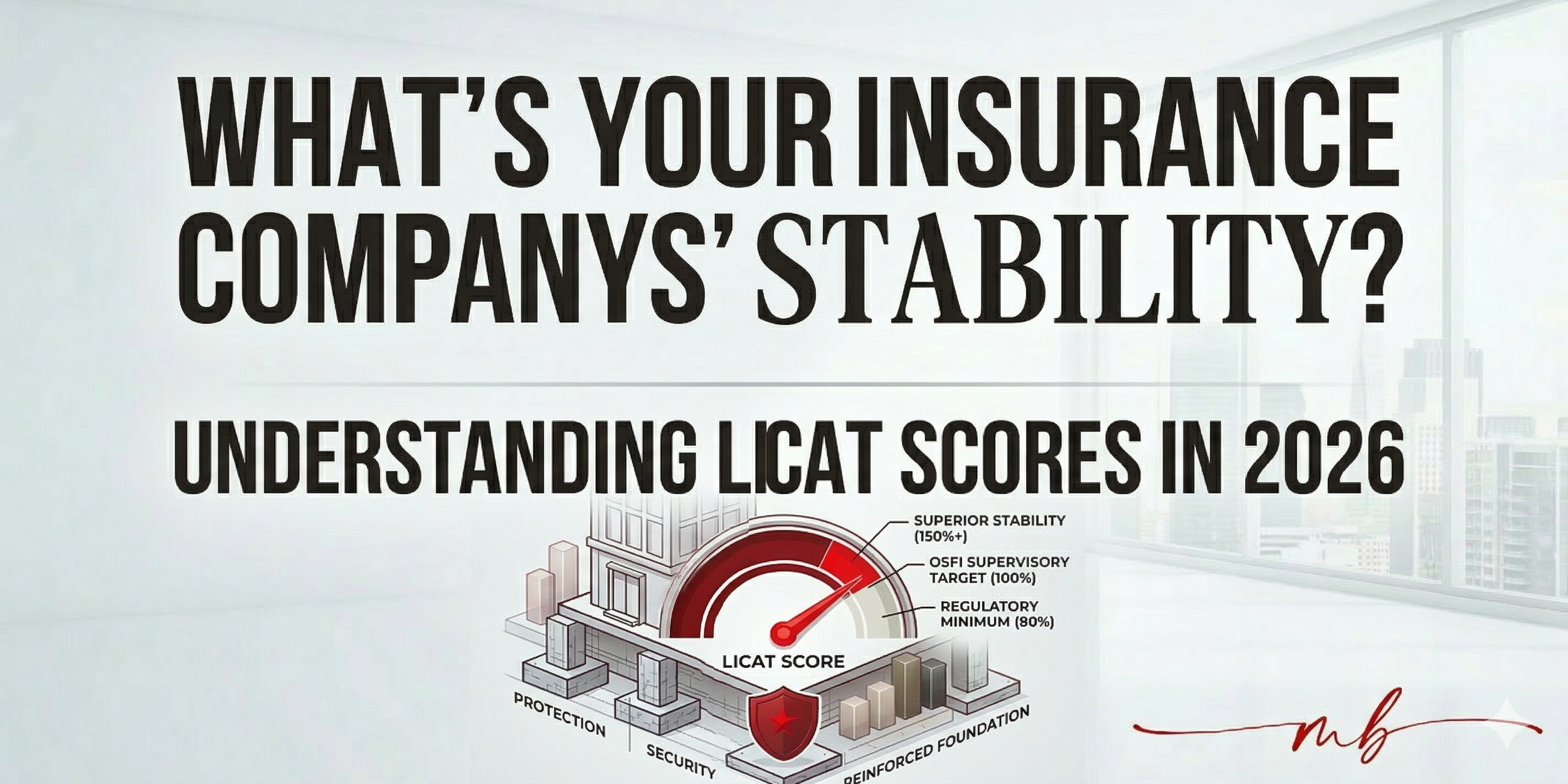
When choosing a life insurance policy, most of the conversation centers on the death benefit and the monthly premium. However, as a professional financial advisor, one of the most critical metrics I evaluate behind the scenes is the LICAT score.
If you are counting on a company to fulfill a financial promise 20, 30, or 50 years from today, you need to know that the company is mathematically equipped to handle economic volatility.
What is the LICAT Ratio?
LICAT stands for the Life Insurance Capital Adequacy Test. Introduced by the Office of the Superintendent of Financial Institutions (OSFI), it is the standard used to measure whether a life insurance company maintains enough capital to absorb potential losses and protect policyholders.
In simpler terms, it is a solvency test. It measures a company's available capital against its risk-weighted assets.
How to Read the Numbers
OSFI sets specific benchmarks that every legal reserve life insurance company in Canada must meet:
90% Core Ratio: The absolute regulatory minimum.
100% Total Ratio: The "Supervisory Target." If a company falls below this, the regulator increases oversight.
140%–170%+ Range: Where the industry-leading Canadian carriers aim to sit to demonstrate maximum stability.
Top Canadian Carriers by LICAT Score (2025/2026)
| Insurance Carrier | LICAT Total Ratio (2025/26) | Financial Position |
|---|---|---|
| Serenia Life (Fraternal) | 177% | Exceptional |
| Equitable Life | 159% | Very Strong |
| Sun Life | 157% | Very Strong |
| Empire Life | 153% | Very Strong |
| iA Financial | 139% | Strong |
| Manulife | 136% | Stable |
When we review your portfolio, we look for companies that don't just meet the minimum, but significantly exceed it. Here is how several major Canadian carriers performed in the most recent fiscal filings:
Why Solvency Matters to Your Family
Financial planning is fundamentally about risk management. While we cannot predict the state of the global economy decades into the future, we can choose to partner with institutions that have substantial built-in "shock absorbers."
A high LICAT score indicates that the insurer has a significant buffer. This means that even in the event of a market crash, a spike in claims, or a sustained period of low interest rates, the company remains solvent and capable of paying out the benefits your family is relying on.
The Engineering of a Plan
Coming from a background in construction and engineering, I view a financial plan through the lens of structural integrity. A high LICAT score is essentially the "reinforced foundation" of your insurance contract. You wouldn't build a house on a foundation that only just met the minimum code; you’d want it to exceed requirements to ensure it stands for generations. Your insurance should be handled with the same scrutiny.
Protecting Your Legacy with Assuris
In addition to LICAT scores, Canadian policyholders are protected by Assuris. This is a not-for-profit organization that protects Canadian policyholders if their life insurance company should fail.
If a member company becomes insolvent, Assuris guarantees that you will retain at least 90% of your promised benefits (with specific caps, such as $1,000,000 for death benefits). When combined with a high LICAT ratio, this creates a two-tier safety net that is among the strongest in the world.
Conclusion
Selecting an insurance provider is a long-term capital decision. It is my responsibility to ensure that the companies we select for your family or your business are not just competitive on price, but superior in stability.
Is your current coverage backed by a high-solvency carrier? If you aren't sure where your provider stands on the LICAT scale, let’s schedule a brief review of your existing policies to ensure your family's protection is built on a solid foundation.