
The Real Threat of a Long Life: Protecting Your Financial Independence Number
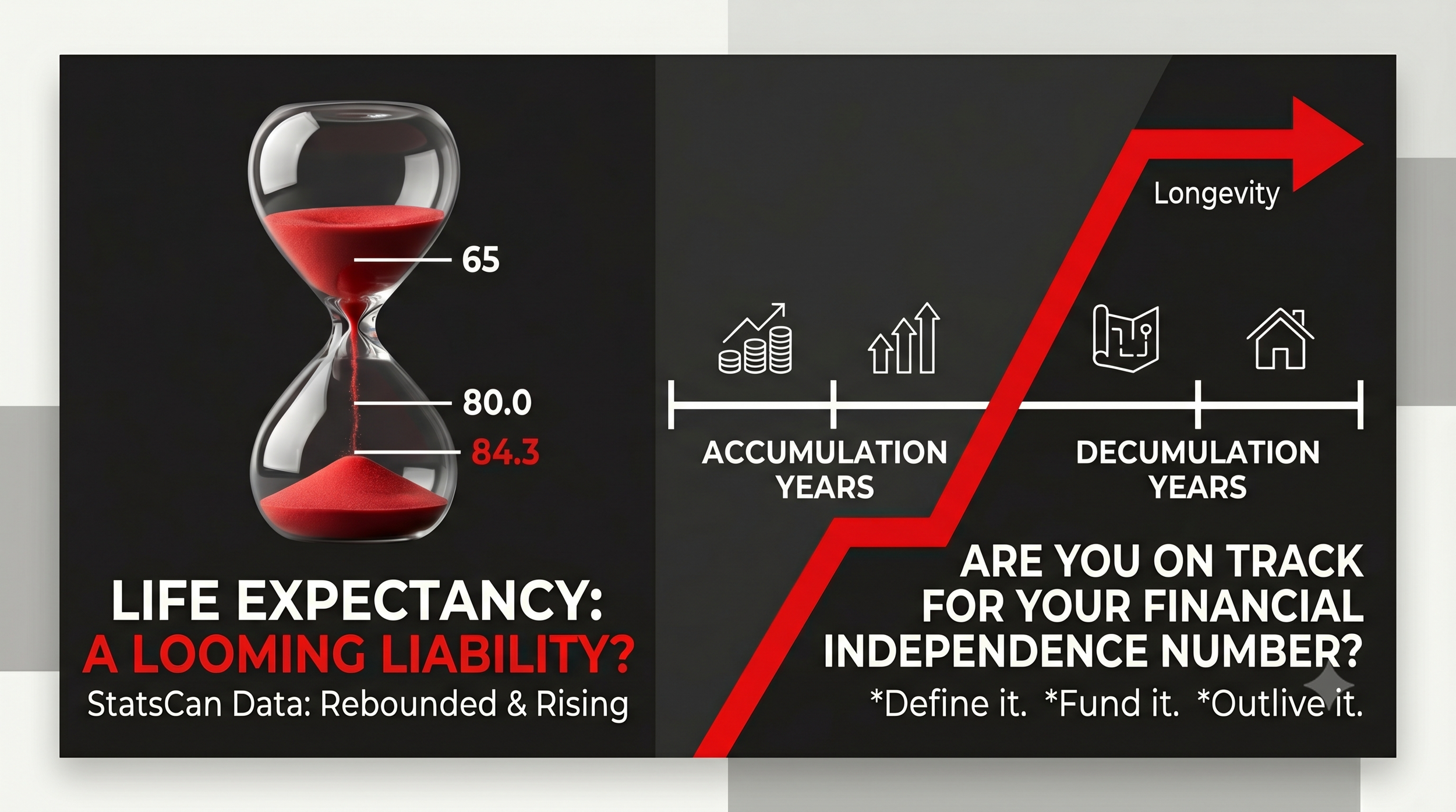
The headlines are calling it a victory: Canadian lifespans have officially rebounded. The latest metrics from Statistics Canada show that life expectancy has climbed back up to 80.0 years for men and 84.3 years for women.
For the average person, that sounds like great news.
But as a financial strategist, when I look at those numbers, I see a massive, looming liability. If you are treating retirement planning like an exact science based on those numbers, you are missing the biggest threat to your wealth: longevity risk.
The Danger of the Average
When you build a wealth strategy around "average life expectancy," you are making a dangerous gamble. An average means 50% of the population lives longer than that number. If your financial plan is built to last until exactly age 82 or 84, you have a coin-flip's chance of outliving your capital.
Outliving your life expectancy is a quiet catastrophe. It means running out of money when you are at your most vulnerable, forced to downsize your lifestyle or rely on others just when you should be experiencing total peace. In the world of wealth protection, a 50% failure rate is completely unacceptable.
Your Financial Independence Number
To avoid this, you need to know your Financial Independence Number. This isn't a vague guess; it is the exact amount of money you need to accumulate to live comfortably without ever needing to trade your hours for dollars again.
Knowing this number gives you clarity. It shifts your focus from arbitrary savings goals to a concrete target. Without it, you are flying blind, guessing how much you can safely spend without draining the tank. Your Financial Independence Number is the foundation of true freedom because it dictates exactly when your money can take over as the primary income earner.
The Two Critical Phases: Accumulation vs. Decumulation
Achieving and maintaining this number requires understanding that your financial life is split into two very distinct block periods:
The Accumulation Years: This is the phase you are likely in right now. Your focus is on growth, efficiency, building assets, and minimizing taxes. You are piling up fuel for the rocket.
The Decumulation Years: This is the phase most people miscalculate. It’s not just about spending your money; it’s about strategically unwinding your assets in the most tax-efficient way possible to ensure they last.
During decumulation, you face the high cost of late-stage healthcare and lifestyle changes. If you don't transition correctly from accumulating wealth to structurally distributing it, a rising life expectancy will eat away your capital fast.
Conclusion
When you look at the math of hitting and protecting your Financial Independence Number over a long lifespan, you really only have three primary levers to pull:
Work longer: Delaying your retirement to shorten the time your money needs to last.
Decrease your goal: Settling for a lesser lifestyle to make the money stretch.
Invest more efficiently: Putting more capital to work right now, allowing compound interest and passive income streams to do the heavy lifting.
True financial peace means choosing the third option. It means ensuring your money works harder than you do so that you can outlive your numbers, rather than your numbers outliving you.
Let's look at your actual corporate and personal structures, stress-test your timeline against true longevity, and build a blueprint that guarantees your peace of mind.
Schedule Your Wealth Strategy Call today and let’s calculate your financial independence number.